Saturday, October 14, 2017

Transit and street life in Lisboa

After days of driving and walking all over the towns we were visiting we thought we'd have a day of taking buses and trams to wander around Lisbon. It didn't quite turn out that way.

We bought two 24-hour transit cards yesterday but only one of them worked. it wasn't really a big deal because we had the cash to pay the 2.80 Euro fare but somehow it put a crimp in our plans to hop on and off trams.  That said, we managed a ride on the "must see" Tram #28, which runs up and down the hills and around sharp turns up to the Afalma district and back down.


Lisbon continues to use (and upgrade the workings) of these cable cars from the early 20th C. While most cities would have put them in a museum Lisbon needs the short size of these cars for some of its twisty routes. It's a very popular tourist route although residents use it as well. To avoid having to stand for the trip we walked up to where the line ends and begins, passing a few more noteworthy tiled buildings, or at lease those that caught my eye...


Once at the top we waited with a few others to board our tram and were able to get seats for the rollicking ride. Here's what it looked like on the tram.  The driver sits in the very middle of at the front and there are lovely polished wooden seats and windows that actually open.
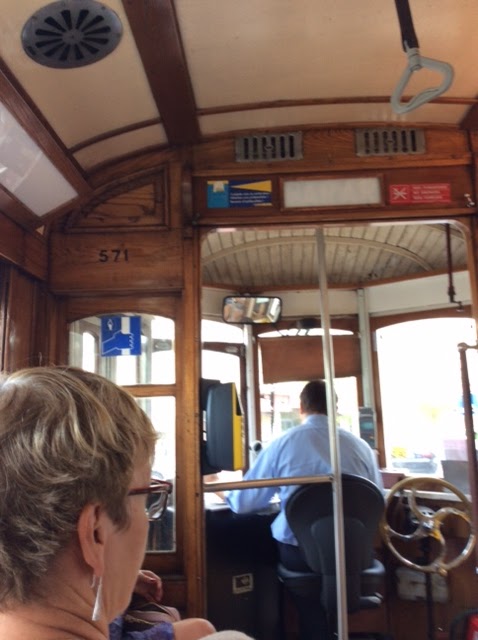


Before very long the tram was crowded with people standing in the aisle. (It has room for 20 seated passengers and 38 standing)


There are large signs on the tram warning of pickpockets; apparently this route is a favourite because of the crowding and the bumpy ride. We took good care this time!  Here's what it looks like passing another tram going downhill. This picture is taken from the window of our tram into the window of one going the other way.


We ended up wandering around the commercial district where the tram ride ended rather than hopping on and of, but that allowed me to sort out a problem with the data on the iPad. We've become used to using it for finding our way around the city and downloading information about museums and sights. When it didn't work this morning we were at quite a loss. Fortunately we found a Vodaphone store and were able to quickly resolve the problem.  

The central part of Lisbon is like most large European cities with fountains and statues and people selling things on pedestrian streets.


We always like seeing the statues with the pigeons roosting on them. These two looked particularly peeved at the indignity.


After a bite of lunch in the touristy area we bused our way home to find our street being set up with chairs. 


I mentioned our street yesterday. It's a kind of grungy narrow almost alley with barely room for a car to get through although from time to time that happens. In the afternoon it's a gathering place for everyone who lives here.  And today I got to enjoy a brass band concert by a small group of children.  


People are very friendly here in spite of our extremely limited communication skills. It's a challenge coming from a country where we have some basic ability to talk to people. Here we feel like dummies whenever we try to communicate. Although Harry is pretty good with sign language.


Things dispersed fairly quickly after the concert was finished. These two young women enjoyed it too. It seems they're waiting to meet their AirB&B host.

One final thing about this neighbourhood, although it seems a bit grubby it is actually a very trendy area, called the design district. This weekend it's hosting a film festival, there's Fado music on the corner and a large number of tiny but good restaurants, wine stores, fruit and vegetable markets and coffee bars. Last night we were lucky enough to get into this hole-in-the-wall Italian place. They were all booked up but allowed us to eat so long as we left my 9:00. (Not an issue for Harry and me!) The food was authentic and fabulous and very reasonable. The Portuguese vinho verde wine is to my taste and Harry likes the red too.


We're gradually finding our way around the neighbourhood.


Friday, October 13, 2017

Azulejos -- Lisbon's signature

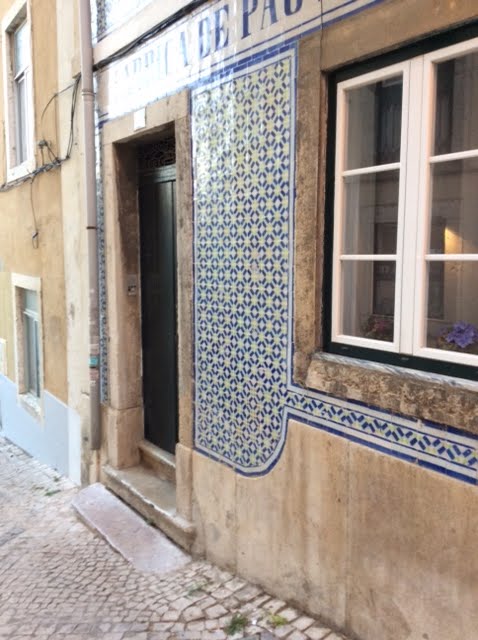
I had heard about Lisbon's tiles (or 'azulejos" in Portuguese) but I was unprepared for how much of the older parts city are covered with them. Even on the taxi ride in from the airport I was seeing buildings completely faced with gorgeous tiles.

In some cases, like this building, they're a decorative addition to a plastered wall. But other buildings are completely covered in tiles, generally all the same design.  It gives a designer look to everything.

This building is just around the corner from where we're staying on a pedestrian only street
We're staying in one of the old traditional parts of the city and we're still trying to figure out the neighbourhood.

Our street is taken over every evening by the families who live there. Old ladies sit outside on chairs knitting and teenagers rove up and down, dogs bark and kids play ball, while men stand around and smoke cigarettes. By 9:00 pm it's all over and people have headed off for dinner and then to bed. I thought maybe it was a poor area but we've seen very well dressed people walking by and there are trendy restaurants that open here at night.

But back to the tiles, here are a few of the tiled buildings we passed on our walk today.


Although many of them are blue, there are many different colours and designs.  The building below has cardboard signs on most of the balconies with words like "respect" "integrity" "inclusion" as well as other positive attributes. Not sure what it's about but the sentiment appeals.


We walked through an area where many of the gorgeous tiled buildings down towards the waterfront were dirty or in disrepair and in some cases abandoned. However we saw signs that some of these beauties are being restored to use.


We finished our day with a visit to the National Museum of Azulejos, which is in an ancient convent building dating back to the 1500s. This is the courtyard. the spire on the right is covered with pale green tiles. Below are some of the rooms in the convent decorated with tiles, and some of the exhibits that show the way tiles were made and all of the different styles from the Moorish through the European as well as contemporary exhibits. 


Even the sidewalks look like they're tiled. They use small blocks of light coloured polished stone.


It was a great first day in an amazing city. We have five more days to explore it before heading home.


Wednesday, October 11, 2017

Los pueblos blancos

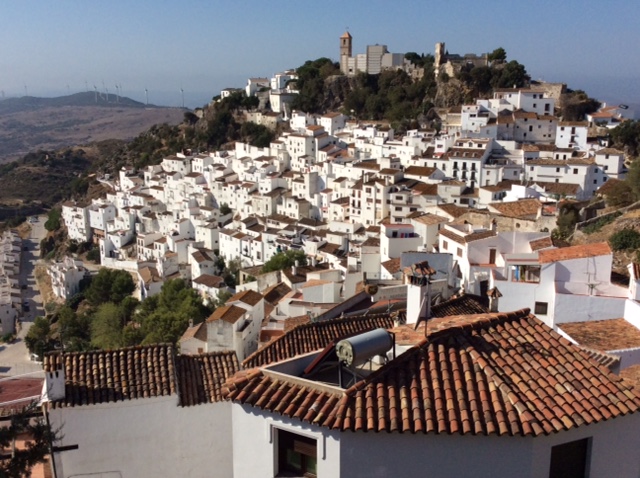
Most of the towns in the south part of Andalusia are old, old, old ones dating back to the time when the Moors occupied Spain or even before. Some of them are 6 and 7 centuries old built with narrow twisting streets and houses close together tumbling down from a hilltop tower. All of the buildings are whitewashed with tile roofs, hence the name pueblos blancos, which in Spanish means white towns. And they are gorgeous!


There are dozens of these towns scattered across the countryside, some high up in the mountains, others on little hills in the middle of the plain. For the past three days we've been driving through this area and we saw a few of them, some close up and some from a distance. Although they're all white, each one has a different feeling. The two above we just drove by on our way up from the coast heading for Ronda.

Here's our little white Fiat Panda parked at the top of one of the towns. Sadly I don't even remember its name, as there are so many of them on this route. Along the road there are viewpoints that you can look across the valleys to see white villages clustered here and there.


This is part of map from one of these viewpoints. It's kind of hard to see but there are at least a dozen villages shown here--and that's just a small part of the area.


The first one we visited in depth was Ronda, which is really more of a white city as it's quite large with a population of 37,000. It's situated high up above a gorge and has been there since the 9th Century BC.  The city was an important Islamic cultural centre and it has a colourful and romantic past in Spanish folklore. We actually stayed about 10 miles outside of Ronda in an old olive mill that's been converted to a lovely hotel, so our experience of it was limited to a walk around the following morning.


The next pueblo blanco we visited was Vejer de la Frontera, which had been recommended to us by the girl in the car rental agency when we asked her about places without a lot of tourists. This town is very old and surrounded by walls. It's absolutely jaw-droppingly beautiful. It did have some visitors but essentially it felt like a real living town with children and dogs in the plazas and people walking by on their way home from church. Here's what it looked like inside the walls.


Finally, just before you get carried away in romantic fantasies, here is a view from the top plaza of Medina Sidonia, another of the car rental girl's recommendations. This may be the oldest city in Europe according to some sources. It's set on a huge hill that rises above the plain east of Cadiz and may have been founded by the Phoenicians in the 2nd Century BC.  The name in Arabic means City of Sidon.


It has medieval walls and narrow cobble streets and a castle too. We walked up to the top of one corner and found this ancient church and had a lovely lunch looking down over the plains below.

Tonight we are in Arcos de la Frontera, yet another white town. We haven't walked around yet as we're in out hotel getting ready for our flight to Lisbon tomorrow. We'll head down to the centro for dinner and I'm sure it will be as beautiful in its own way as the others.

By the way, our hotel is in a white building with a top floor that's like a large open patio. Here is where I'm sitting writing this post. Isn't it lovely?  It's actually called a Hostal, a basic hotel, and we love it, especially for the 33 Euro price.


Tuesday, October 10, 2017

On the road with and without the pilgrims


It's been a few days since I posted here. We've been driving from place to place staying at a different spot each night. It's much more tiring and stressful, especially when we arrive in larger cities like Cordoba and Granada so I haven't been up to blogging. Each time we get into one of these cities we make a wrong turn and become hopelessly lost in one-way streets.

Both Cordoba and Granada are tourist meccas where busloads of pilgrims (tourists really) from foreign lands come in during the day to take guided tours of the hot spots.

During the day these places are so crowded that it's not pleasant to be there.We elect not to take guided tours because although you can jump the lineup you then have to stay with the group and listen to endless details that keep you from absorbing the feeling of the place. Of maybe we're just cheap. When we were in Cordoba we found out that you can get into the most famous mosque / cathedral known at La Mezquita for free every morning from 8:30 to 9:30. Getting up early to visit places also avoids the tour bus crowds, which usually arrive about 10:00.

La Mezquita is exquisite and also weird as it's a blend of Moorish and Christian styles. The Arabs built it beginning in 784 over an earlier Christian church that was shared by both faiths. Over several centuries the mosque was expanded until 1286 when Cordoba returned to Christian. The Christians proceeded to build a Renaissance style nave inside the mosque. The building is a mix of both styles but central part of the Mezquita is an enormous hall of columns and arches that is very Moorish indeed. It was a humbling experience walking around this enormous building in the dimness and quiet with only a few other people. Getting up early also allows us to see the first rays of the sun on some of these special places.


Our second night out we spent in Granada. Our plan was to go to see the world famous Alhambra, but fate intervened. A couple of days before going there I went online to get tickets, only to find that there were none available. All were sold out until the end of October. I felt kind of stupid about that since we've known for months that we would be there on that date.  However we did discover that it's free to enter part of the monument so that's what we did.

We got a taxi early in the morning (before it was even light) to go visit what we could.  We were able to go inside the walls of this huge fortress and see a few arches and gates. It's built high on a bluff and clearly dominated the city. Here's the view from the top and a peaceful garden in what was at one time a monastery and is now one of Spain's Parador hotels.


All the buildings are of a reddish stone and you can see the red in the soil as well. Here's a view through a wall that was built of the same red coloured stone.


It was interesting to see this fort and palace that takes up a huge chunk of land but it wasn't the same as going inside. However, as Harry said--and I know he's right--we wouldn't have seen anything more wonderful than what we saw in Cordoba and Sevilla.

Of course we saw many other parts of these two famous cities but these buildings are what the tourists make their pilgrimages for. We've decided now to visit smaller towns to avoid the busloads full of tour groups.

We spent Sunday night just outside of Estepona, a smaller town on the Costa del Sol after driving through miles of high rise and sprawling developments in Malaga, and Fuengirola. This part of Spain has been taken over by Brits who come here for their winter holidays.  We stopped at one place for a drink and a snack only to find the menu entirely in English and everyone there looking like they'd just stepped out of a village in East Grinstead. It's kind of like what has happened in parts of Mexico with visitors from Canada and the USA. Not that it's all bad--I'm sure that Spain benefits greatly from this influx, but that's not what we came to Spain to see.


Here's what we found in Estepona: a prettied up village with a nice promenade along the water and a mix of Spanish and English speaking residents, plus good restaurants and a bronze statue of a fellow reading a newspaper. He could be British or Spanish I guess. I tried to speak with him but got no response..


Yesterday we headed inland to see the famous white villages. I'll catch you up on that tomorrow.